Best Sealants for Roofs & Patio Covers in Southern California | What Actually Lasts
Most sealants fail in SoCal sun within a few years. Learn which ones actually last for roofs and patio covers in Menifee, Murrieta, and Temecula.
Scott Egbert, owner of SAE Buillders
4/12/20262 min read
Best Sealants for Roofs and Patio Covers in Southern California (What Actually Lasts)
Sealants look simple. Cut the tube, squeeze, tool it, done.
That mindset is exactly why they fail.
In areas like Menifee, Murrieta, and Temecula, sealants are exposed to extreme sun, heat, and constant expansion. Choosing the wrong product can mean cracking, leaks, and callbacks within a few years.
This guide breaks down the most common sealant types, where they work, where they fail, and what actually holds up in real-world Southern California conditions.
Why Sealant Selection Matters
Sealants on roofs and patio covers deal with:
Intense UV exposure
Daily expansion and contraction
Different materials moving at different rates
No single sealant handles all of this perfectly. The key is using the right product in the right location.
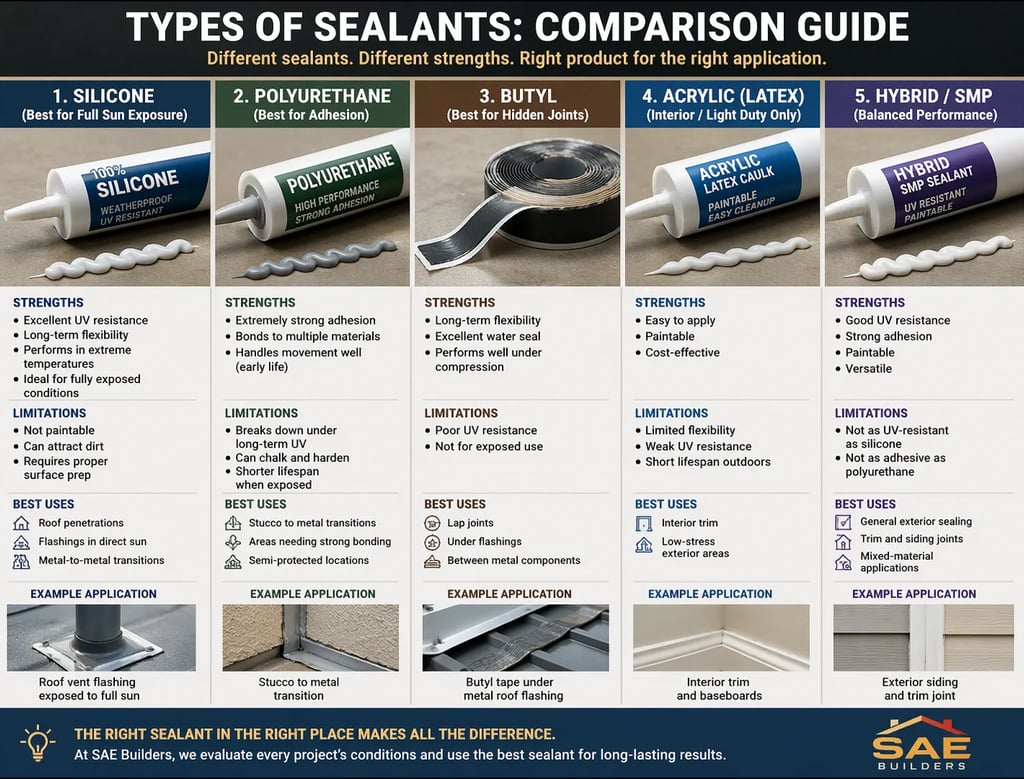
1. Silicone Sealants (Best for Full Sun Exposure)
Strengths
Excellent UV resistance
Long-term flexibility
Performs in extreme temperatures
Ideal for fully exposed conditions
Limitations
Not paintable
Can attract dirt
Requires proper surface prep
Best Uses
Roof penetrations
Flashings in direct sun
Metal-to-metal transitions
👉 Real Example:
On many patio cover repairs in Menifee, exposed sealants fail early unless silicone is used. It consistently outperforms other products in full sun.
2. Polyurethane Sealants (Best for Adhesion)
Strengths
Extremely strong adhesion
Bonds to multiple materials
Handles movement well (early life)
Limitations
Breaks down under long-term UV
Can chalk and harden
Shorter lifespan when exposed
Best Uses
Stucco to metal transitions
Areas needing strong bonding
Semi-protected locations
👉 Real Example:
We frequently see polyurethane sealants in Temecula begin to chalk and degrade in 5–7 years when exposed to full sun.
3. Butyl Sealants (Best for Hidden Joints)
Strengths
Long-term flexibility
Excellent water seal
Performs well under compression
Limitations
Poor UV resistance
Not for exposed use
Best Uses
Lap joints
Under flashings
Between metal components
👉 Real Example:
Butyl tape is commonly used between patio cover connections where it remains protected from sunlight.
4. Acrylic (Latex) Sealants (Interior / Light Duty Only)
Strengths
Easy to apply
Paintable
Cost-effective
Limitations
Limited flexibility
Weak UV resistance
Short lifespan outdoors
Best Uses
Interior trim
Low-stress exterior areas
👉 Reality:
Not suitable for roof or patio cover applications in Southern California sun.
5. Hybrid / SMP Sealants (Balanced Performance Option)
Strengths
Good UV resistance
Strong adhesion
Paintable
Versatile
Limitations
Not as UV-resistant as silicone
Not as adhesive as polyurethane
Best Uses
General exterior sealing
Trim and siding joints
Mixed-material applications
👉 Real Example:
Hybrid sealants are often used where both appearance and durability matter, but full UV exposure is limited.
Real-World Sealant Strategy (What Actually Works)
Professional installations don’t rely on one product.
Typical approach:
Full sun exposure: Silicone
High adhesion needed: Polyurethane or hybrid
Hidden joints: Butyl
Interior work: Acrylic
👉 In many cases:
Polyurethane is used for bonding
Silicone is used as a protective top layer
This combination improves both adhesion and long-term performance.
Common Sealant Failures (And Why They Happen)
Most failures are not product defects.
They come from:
Using the wrong sealant for the environment
Poor surface preparation
Applying too thin
Ignoring material movement
Even the best sealant will fail if used incorrectly.
How SAE Builders Chooses the Right Sealant
At SAE Builders, sealant selection is based on real-world performance, not convenience, or cost!
Each application is evaluated based on:
Exposure to sunlight and weather
Materials being joined
Expected expansion and movement
Long-term durability requirements
We routinely see failed sealants during repairs across Menifee, Murrieta, and surrounding areas. These failures are almost always due to improper product selection or application.
Rather than relying on a single “go-to” product, we match the sealant to the specific conditions of each project.
👉 The goal is simple:
Use the right material in the right place the first time.
Patio Covers and Exterior Projects
If you’re planning a patio cover or exterior upgrade, sealant selection plays a major role in long-term durability.
Learn more about:
Final Thoughts
Sealants are one of the smallest components in a project, but they often determine how long that project lasts.
Choosing the right one is not about brand or convenience. It’s about understanding how materials perform under real conditions.
In Southern California sun, that difference shows up fast.